
How should a suit vest fit?
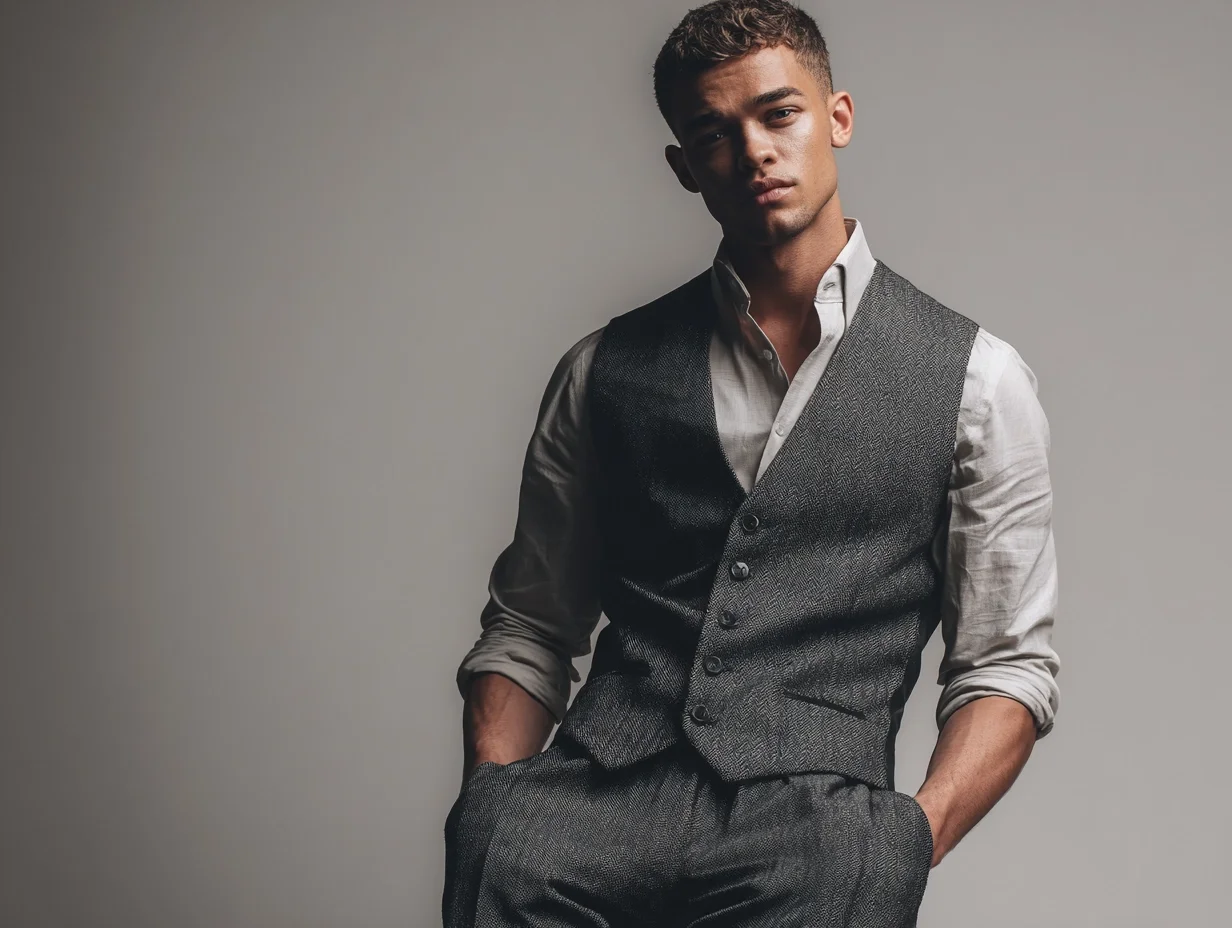
The suit vest, or waistcoat, plays a distinctive role in tailoring. It is worn close to the body and designed to refine the silhouette beneath a jacket. Because of this, issues with vest fit can be subtle at first but quickly become apparent in wear. A well-fitted vest should contribute to the overall line of the suit without asserting itself visually.
Overall fit through the body
The vest should fit closely enough to the body that it does not create a visible outline, ridges, or extra bulk beneath the jacket. This does not mean that the vest itself is hidden when the jacket is worn. In a three-piece suit, the vest is of course meant to be seen. What should not be visible is the vest’s shape telegraphing through the jacket fabric.
A properly fitted vest lies smoothly against the torso, following the chest and waist without pulling at the buttons or creating tension across the front. When a vest is cut too loose, excess fabric can bunch or ripple under the jacket, disrupting the clean line of the suit. The goal is a controlled, streamlined layer that supports the jacket rather than interfering with it.
At the same time, the vest must remain comfortable. You should be able to sit, stand, and move easily without feeling compressed. A close fit should feel secure, not restrictive.
Length and coverage
Vest length is largely a matter of personal preference, but there is an important practical guideline. We recommend that the vest extend below the waistband of the trousers. This ensures that the shirt is fully covered and that no gap appears between vest and trousers when standing, walking, or sitting.
A vest that is too short breaks the continuity of the suit and undermines the purpose of wearing a waistcoat in the first place. Proper length maintains a clean transition from jacket to trousers and reinforces the integrity of a three-piece suit.
Relationship to the jacket
A vest should work in harmony with the jacket. When the jacket is buttoned, the vest should not create visible bulges, lines, or impressions through the jacket fabric. These are usually signs that the vest is either too loose, incorrectly shaped, or not properly balanced.
This is why vest fit cannot be treated as an afterthought. Even small excesses of fabric can compromise the appearance of the jacket.
The role of bespoke fitting
At B. Kreps, vest fit is resolved as part of the bespoke process, not corrected afterward. Using a try-on garment during the first fitting to capture numerous fit points on the body, we are able to take into account posture, balance, and proportion when drafting your unique pattern, so the vest integrates perfectly into the finished suit.
When fitted correctly, a suit vest adds structure, polish, and comfort. It supports the overall silhouette quietly and precisely, doing its job without ever demanding attention.
Come and visit us at one of our showrooms in Houston or book an appointment for your first bespoke commission.
Heights
2313 Edwards Street
Unit 115
Houston, Texas 77007
(281) 799-4872
Downtown Tunnel Loop
919 Milam Street
Unit T0700
Houston, Texas 77002